
The Community Bank Capital Problem – Too Much

By: Gary J. Young, President & CEO

The Mantra
As community bankers, we have all heard the mantra to increase capital. This is heard by the banker who has an 8% leverage ratio and needs to increase capital to 9%, by the banker who has a 9% leverage ratio and needs to increase capital to 10%, and by the banker who has a 10% leverage ratio and needs to increase capital to 11%. Based on this view regarding capital, more is always better. I disagree.

Capital Adequacy
I agree with the OCC. Capital adequacy at each bank is uniquely based on the current and planned risk within the bank. And, it is the responsibility of the bank board to determine capital adequacy with the input from executive management. Capital adequacy is the point at which a capital contingency plan is implemented if actual capital falls below that point. In other words, let’s assume capital adequacy has been defined as a 7.5% leverage ratio, or a 11.25% total risk-based ratio. If actual capital falls below either measure, the bank should implement the methodology for improving capital as described in the capital contingency plan.

Capital Target
A bank’s target or goal for capital is higher than capital adequacy. It is an estimate of the amount the board of directors has decided is desired to take advantage of opportunities such as additional organic growth, branch expansion, purchase of a bank or branch, stock repurchase, etc.; or to use as additional insurance or protection against negative events that could hurt profitability and capital. As an example, a 7.5% leverage ratio could be defined as capital adequacy, but the target level of capital is 9.0%.

Cost
Excess capital has a cost. Let’s assume you had to eliminate $1 million of excess capital. To balance that transaction, you would also eliminate $1 million in assets which would be investments. Let’s assume that the investments had an average yield of 1.5%. After taxes, that would be approximately 1.0%. Based on this example, the return on equity of the $1 million of excess capital is 1.0%. We must agree that 1.0% is unacceptable. Well, it is unacceptable unless that is your return for opportunity capital or insurance capital as described above.
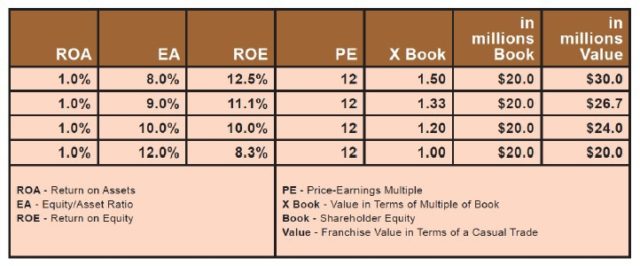
Another example of the cost of excess capital can be seen here. There are four banks with a 1% ROA. However, the equity/asset ratio at each is different, ranging from an 8.0% leverage ratio to a 12.0% leverage ratio. By dividing the ROA by the leverage ratio, you get the ROE. By multiplying the ROE by an assumed PE, you get the multiple of book. In this example, the bank with an 8.0% leverage ratio has a value of $30 million while the bank with a 12.0% leverage ratio has a value of $20 million. This is a simplified example that provides information on the cost of excess capital.

The Right Amount
There is no right amount. The average less than $1 billion bank has a 10.8% leverage ratio and a 16.6% total risk-based capital ratio. Most everyone would agree that banks do not need that level of capital. But, every bank is unique with different levels of risk and different levels of risk appetite. The important thing is that executive management and the board of directors understand that there is a shareholder cost to holding excess capital.
That doesn’t make it wrong. The board of directors has multiple responsibilities and at times they can be conflicting. From the shareholder perspective, you want to maximize the return on equity and shareholder value which assumes leveraging capital, but you must also oversee the operation of a safe and sound bank. And, at the heart of safety is capital adequacy. It takes balance and awareness of both to determine the right level of capital for the bank. My concern is that through the Great Recession and after, the capital mantra has been “more is better.” Well frankly, more is not necessarily better. I am suggesting that it is time to balance the capital need for risk management with the capital need for improving shareholder value.

Best Practices
The question for executive management is what should I do? It is my opinion that best practices would indicate that every bank develop a definition of capital adequacy based on inherent risk. Furthermore, a capital contingency plan should be part of that plan that indicates the steps the bank might take if capital falls below or is projected to fall below your definition of capital adequacy. You should then have a frank discussion at the board level on the amount of capital that is your goal or comfort level. If you then find that your capital is above that, consider the following:

  • Focus on additional organic growth, if possible.
  • Expansion opportunities. I would suggest looking for opportunities that begin turning a profit in two years or less.
  • A stock repurchase plan. This is a win for the shareholders that want to sell and the shareholders that want to hold. Everyone wins and shareholder value should increase.
  • A slow, steady increase in dividends to shareholders.

Consider how all of these items might impact your capital adequacy, return on equity, and shareholder value over a 3-5 year period. Remember, the goal of executive management is to maximize profitability and shareholder value within capital guidelines approved by your board of directors.

For More Information
If you would like to discuss this article with me, you can contact me 1.800.525.9775 or click here to send an email.

Employee Retirement Income Security Act (ERISA) Compliance — Recent Changes

By: Sharon Jeffries, Human Resources Manager

Did you know?

Recent changes to the health and welfare side of the federal Employee Retirement Income Security Act (ERISA) now mandates that all employers/plan administrators provide a Summary Plan Description (SPD) to each plan participant and that ERISA-covered plans be maintained in accordance with a written Wrap Plan Document.

The SPD is an important document that tells participants what the plan provides and how it operates. If a plan is changed, participants must be informed, either through a revised summary plan description, or in a separate document, called a summary of material modification, which also must be given to participants free of charge.

A Wrap Plan Document is designed to meet plan documentation requirements under ERISA and other federal laws and to incorporate all other welfare plans, insurance contracts and other relevant documents into a single plan. These materials can be kept together for administrative ease. The Wrap Plan Document provides additional legal protection for the employer and plan fiduciaries and can simplify plan administration.

What does that mean?

In the past, much of the regulatory focus was on the retirement side of the ERISA legislation. However, with the implementation of the Patient Protection and Affordable Care Act (PPACA) that has changed.  Much of the current government monitoring, oversight, and auditing relates to the health and welfare side of the ERISA regulation.

ERISA now requires employers who are plan administrators of their group health plans to comply with two (2) critical requirements or they will risk potential penalties and possible government audits.

Those requirements are:

  • Maintain and distribute SPD’s to plan participants which accurately reflect the contents of the plan and which include specific information as required under federal law.
  •  Group health plans must be administered in accordance with a written Plan Document which must be made available to plan participants and beneficiaries upon request.

Are you at risk?

Yes, and the reason is this: Many banks will mistakenly assume that insurance contracts, certificates of insurance and benefit summaries fulfill the ERISA requirements for an SPD and Plan Document, but they do not.  And, the primary reason is they do not include the required or recommended provisions that protect the plan and the employer.

What should you do?

Recognize that:

  • Failure to provide an SPD or Plan Document within 30 days of receiving a request from a plan participant or beneficiary will result in a penalty of up to $110/day for each violation
  • Lack of an SPD could trigger a plan audit by the United States Department of Labor (DOL)
  •  The United States DOL has increased its audit staff and national enforcement initiatives to investigate employers’ compliance with Health Care Reform, resulting in companies of all sizes  being audited and being required to provide an SPD and Plan Document

The Solution

Do not try to create these in house. Allow experts in the areas of benefits and benefits regulations assist you with this monumental effort.  Young & Associates, Inc. has partnered with The Alpha Group Agency, Inc. to offer our clients this unique service.  The Alpha Group Agency, Inc. is a highly skilled, reputable organization involved in the management of health insurance services as well as other related subjects.

The Alpha Group Agency, Inc. has been an advisor to Young & Associates, Inc. for almost fifteen (15) years in the management of its group health insurance plans. For additional information on how you can become compliant with these critical ERISA regulations and also lower the risk of a DOL audit, contact Sean Nehlsen, The Alpha Group Agency at 800-886-3315 or snehlsen@thealphaga.com.

Executive Search and Interim Management Services

By: Sharon Jeffries, Human Resources Manager

All banks face changes in management and other key positions from time to time. These changes can be due to retirements, relocations, unsatisfactory work performance, as well as other factors. All of these situations can put your bank in difficult and unique situations that generally cannot be quickly resolved.

Don’t rush to fill the vacancy by placing a candidate/current employee in a position that may provide temporary support, but results in a poor fit for the long-term, lacking the skills and experience needed to meet the ever changing regulatory banking climate.

What should you do?
If you find yourself in this situation, Young & Associates, Inc. can help by becoming an extension of your Human Resources Department. We will work with management and discuss options for your bank to meet both its short-term and long-term staffing needs.

If we find that the skill set/experience level desired is such that it will take additional time to source the “right” candidate for the position, we will present “interim” solutions, while beginning to search for a candidate that will be a more long-term solution for your organization.

One “interim” solution may be contracting with Young & Associates to put one of our accomplished consultants on-site at your bank to assist in covering those critical areas while continuing the search for a more permanent option. Another option would be for Young & Associates to provide you with a seasoned individual who may be looking for project and/or short-term work. Through years of experience in the financial services industry, we have developed an extensive network of contacts and resumes of individuals with a broad knowledge base in critical areas that are needed in banking today.

We can customize the services we offer to meet the ever-changing workforce needs of your bank. Although some of what we offer is similar to traditional search firms, several differences set us apart from other firms. Our knowledge of the skills necessary to be successful in banking today, along with the ability to utilize our in-house experts throughout the process, are key differences. Also, our professional fee structure is generally lower than traditional placement firms. However, most importantly, our reputation is proven effective. Young & Associates is reliable with more than 35 years successfully serving banking clients.

To learn more about these unique staffing services, contact Sharon Jeffries, Young & Associates, Inc.’s Manager of Human Resources. Sharon has over 25 years of experience in Human Resources Management and can be contacted at 800.525.9775 or you can click here to send her an email.

Connect with a Consultant

Contact us to learn more about our consulting services and how we can add value to your financial institution

Ask a Question