
By Bill Elliott, CRCM; director of compliance education, Young & Associates
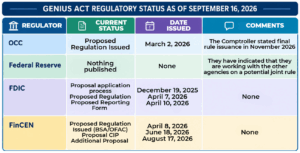
The GENIUS Act was passed in 2025 and signed into law July 20, 2025. At the end of this article, we have prepared a summary of each regulator’s status regarding Where they are in their process to create implement regulations for this new law. The law itself states that the Act becomes effective January 18, 2027, regardless of the status of the presence of implementing regulations. We hope that the regulatory process is complete prior to the implementation date, as it will lead to confusion and probably additional efforts for both regulators and financial institutions.
Below is a general description of exactly what the rule actually requires.
Requirements for Issuing Payment Stablecoins (from Congress.gov)
“The act defines payment stablecoin as a digital asset issued for payment or settlement and redeemable at a predetermined fixed amount (e.g., $1). U.S. payment stablecoin issuers (unless falling under the act’s exceptions) must be approved by a state or federal regulator, as described below. Issuers are required to hold at least one dollar of permitted reserves for every one dollar of stablecoins issued. The GENIUS Act limits permitted reserves to coins and currency, deposits held at insured banks and credit unions, short-dated Treasury bills, repurchase agreements (“repos”) and reverse repos backed by Treasury bills, government money market funds, central bank reserves, and other similar government-issued assets approved by regulators.
Issuers may use reserve assets only for certain activities, including to redeem stablecoins and offer them as collateral in repos and reverse repos. The act requires federal and state regulators to issue tailored capital, liquidity, diversification, and risk management rules for federal and state stablecoin issuers, but it exempts stablecoin issuers from the regulatory capital standards applied to traditional banks.
Issuers are required to establish and disclose stablecoin redemption procedures and to issue periodic reports of outstanding stablecoins and reserve composition, which must be certified by executives and “examined” by registered public accounting firms. Those with more than $50 billion in stablecoins outstanding are required to submit audited annual financial statements. Issuers are prohibited from paying interest to stablecoin holders, but holders are not defined, and there is no restriction against exchanges paying interest to customers.”
Other regulations that face changes
In addition to the requirements above, the Bank Secrecy Act and the Financial Crimes Enforcement Network (FinCEN) must write tailored anti-money-laundering (AML) rules. The Act requires that FinCEN facilitate “novel methods … to detect illicit activity involving digital assets.”
The GENIUS Act will require any financial institution to certify that they have implemented appropriate AML and sanctions compliance programs.
Once completed, there likely will be additional responsibilities for your BSA staff. As part of the BSA process, it may require additional software or more upgrades to any current software you own.
The FinCEN proposal was issued in April 2026 and revolves mostly around Customer Identification issues. A Fact Sheet regarding the Notice of Proposed Rulemaking can be found at: https://www.fincen.gov/system/files/2026-04/FactSheet-PPSI-program-NPRM.pdf. OFAC will also need to be modified, but probably without major changes.
Issuing stablecoins
Stablecoins can be issued by several types of financial institutions, although non-banks will be restricted. Banks must apply to their relevant federal banking regulator. Applications must be evaluated based on whether the stablecoin issuers can meet the baseline requirements. The regulators must render a decision within 120 days, or the application will be deemed approved. Regulators must justify denials and permit applicants to appeal.
Federal regime supervision and enforcement
Any insured bank or nonbank issuer that opts for the federal regime or has more than $10 billion in issuance will be supervised by the regulator who evaluates their financial condition, risks to firm and financial system safety and soundness, and risk management systems. This will likely lengthen and complicate safety and soundness examination process. Additionally, there will be an increase in the reporting requirements outside of the safety and soundness examinations. This will mean extra efforts for your bank.
Regulators are authorized to stop a permitted issuer from issuing stablecoins or to issue other enforcement actions if necessary.
Other supervision and enforcement
In addition, depending upon your state regulators and perhaps law, state regulators will also be examining compliance with this Act. State regulators may cede their authority, but it is possible that state-chartered institutions will face additional state examinations as well.
Foreign Issuers
The GENIUS Act establishes requirements for the issuance of payment stablecoins by foreign issuers as well. That is beyond the scope of this article.
Other provisions
Other provisions address a number of topics, including stablecoin assets and reserve custodian issues. The law does permit banks to hold stablecoins and reserves in custody, use blockchains, and issue tokenized deposits.
Stablecoin holders receive priority over all other claims against the issuer in bankruptcy. This allows a bankruptcy court to issue automatic stays.
Payment stablecoins are not securities or commodities and are not federally insured.
The law prohibits those issuing stablecoin cannot represent stablecoin as being as beoing issued or guaranteed by the U.S. government.
Conclusion
Each financial institution will need to consider whether to participate. It is likely that banks who have clients who do business outside the United States will be most interested. But participation will also come with additional costs and responsibilities. Financial institutions will need to evaluate their situation carefully before entering the world of stablecoin.


